Introduction
Building backend services is rarely just about writing functions that return JSON data. It's about designing a robust foundation that can scale, securely authenticate users, and seamlessly communicate with the frontend. During my early career as a software engineering student at UGM, I took on roles as a Back End Developer at Find IT! UGM and later progressed to Sub-Manager of Backend Services at Technocorner.
These roles challenged me to move beyond simple prototypes and build production-grade architectures. In this post, I reflect on the key technical lessons learned from managing these projects, focusing on database modeling, authentication, and frontend integration.
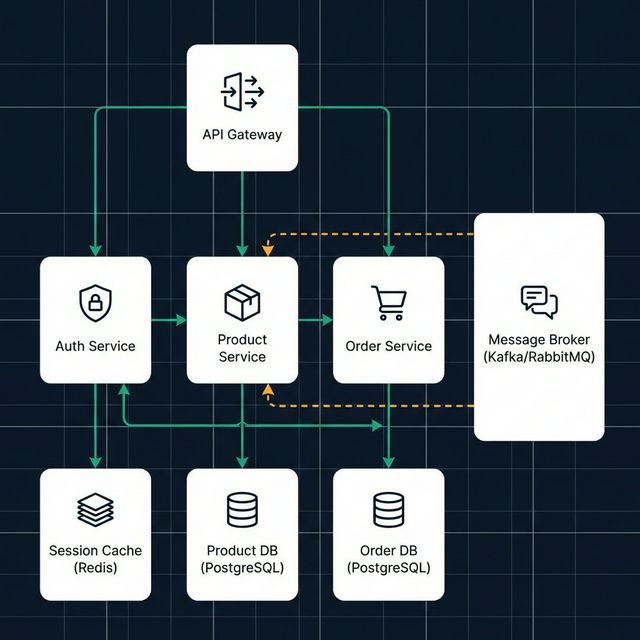
The Foundation: Database Design and ERD
Before writing a single line of API code at Find IT! UGM, the most critical step was designing the Entity-Relationship Diagram (ERD). When building a web application designed to handle student registrations, competition submissions, and user profiles, the database schema dictates the performance and scalability of the entire system.
We opted for MongoDB as our primary datastore. While NoSQL databases like MongoDB are inherently schemaless, structuring the data conceptually via ERDs was still vital to understand data access patterns.
By explicitly mapping out these relationships, we ensured that our queries using Mongoose (the MongoDB ORM for Node.js) were optimized, avoiding unnecessary data duplication and expensive lookup operations.
Securing Access: Authentication with JWT
Security is the bedrock of any backend system. At both Find IT! and Technocorner, we implemented robust authentication and authorization flows utilizing JSON Web Tokens (JWT).
Instead of relying on stateful server sessions which can become bottlenecks as traffic grows, JWT allows for stateless authentication.
The JWT Flow Implementation
When a user logs in, the unified Node.js/Express.js server validates the credentials and issues a signed token.
// Example: Generating a JWT after successful login
const jwt = require('jsonwebtoken');

const generateToken = (user) => {
  // Payload contains non-sensitive identification data
  const payload = {
    id: user._id,
    role: user.role
  };

  // Sign the token with a secret key and set an expiration
  return jwt.sign(payload, process.env.JWT_SECRET, {
    expiresIn: '1d' // Token expires in 1 day
  });
};
This token is then passed by the client in the Authorization header for subsequent requests. We built custom middleware in Express.js to intercept requests, verify the token signature, and restrict access based on the user's role (e.g., standard user vs. admin).
Seamless Integration: Connecting Node.js with Next.js
When I transitioned to the Sub-Manager role at Technocorner, the scope expanded from just building APIs to ensuring they integrated flawlessly with the frontend architecture, which was built on Next.js.
The challenge was orchestrating the flow of web application data—handling complex CRUD (Create, Read, Update, Delete) operations without bottlenecking the user interface.
Strategies for Next.js Integration:
- CORS and Security Headers: Configuring the Express server to securely accept requests from the Next.js frontend domain while blocking unauthorized origins.
- Standardized API Responses: Establishing a strict JSON response format (e.g.,
{ success: true, data: {...}, message: "..." }) so the frontend developers could build predictable state management and error-handling routines. - Data Fetching: Leveraging Next.js's data fetching methods (like
getServerSidePropsorgetStaticProps) to pre-fetch critical data from our Node.js APIs, significantly improving the initial page load speed for end-users.
Conclusion
Transitioning from a Back End Developer to a Sub-Manager fundamentally shifted my perspective. I learned that writing the code is only half the battle; the other half is architectural design, security implementation (JWT), and establishing clear communication contracts with the frontend team.
The hands-on experience with Node.js, Express.js, and MongoDB built a solid foundation that I continue to rely on when designing more complex, scalable microservices today.