Introduction
The role of a backend engineer is rapidly evolving. We are no longer just writing logic and managing databases; we are increasingly becoming orchestrators of complex, automated systems. The advent of Large Language Models (LLMs) promised to help us code faster, but the real revolution lies in Agentic Engineering—moving beyond simple code completion to autonomous agents that can manage entire workflows.
In this post, I’ll dive into my personal project, 'Backend-Super-Skills', a framework designed to empower AI agents with the specific tools and conventions they need to execute backend tasks reliably.
The Core Triangle: Skills, Rules, and Workflows
Most AI assistants today operate in a vacuum—they have no memory of your specific project standards or the sequence of steps required to deploy a new microservice. 'Backend-Super-Skills' solves this by structuring agent capabilities around three pillars:
1. Skills (The Tools)
Skills are discrete modules of functionality. For example, a db-optimizer skill allows the agent to analyze slow queries and suggest indexes. A log-parser skill allows it to consume ELK stack data and identify patterns in 500 errors.
2. Rules (The Guardrails)
Rules define how the agent should behave. These are not just linting rules, but architectural constraints. If your project mandates a specific naming convention for SQL migrations or a Zero-Trust approach to API authentication, the agent must be aware of these rules before it writes a single line of code.
3. Workflows (The Orchestration)
Workflows are the "recipes" for complex tasks. Automating a backend workflow isn't just about writing code; it’s about the sequence:
- Analyze the requirement.
- Draft the implementation plan.
- Execute the changes.
- Verify via automated tests and monitoring.
Infrastructure Architecture
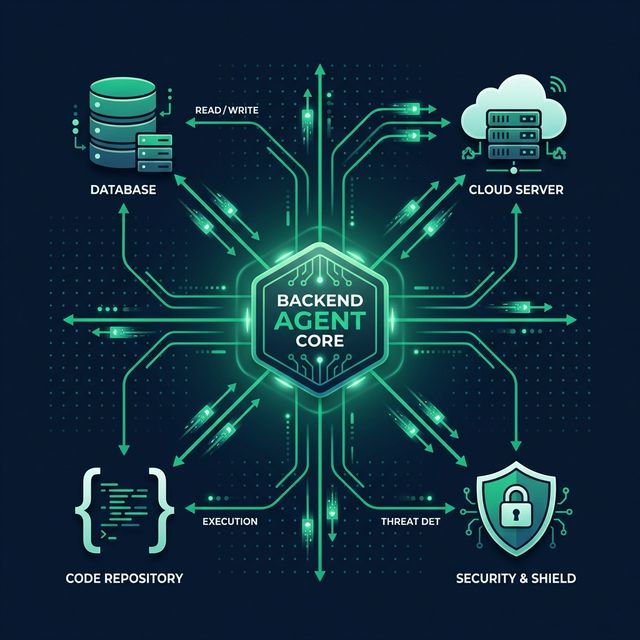
To build a reliable backend agent, we need a robust communication layer. Below is the high-level architecture of how my framework interacts with the development environment.
Moving Toward the Self-Healing Codebase
The ultimate goal of 'Backend-Super-Skills' is to move toward a proactive backend. Imagine an agent that detects a spike in latency, traces it to a specific service, realizes a database connection pool is exhausted, and automatically scales the service or optimizes the connection management logic.
We aren't just building faster bots; we are building autonomous collaborators that understand the context of our unique backend architectures.
Conclusion
Automating backend workflows is more than just script writing; it’s about capturing the "Super-Skills" of experienced engineers into a framework that AI agents can execute with precision. As AI continues to integrate deeper into the SDLC, the differentiator for backend engineers will be their ability to design these agentic systems and define the rules that keep them safe and efficient.
Keep building, and stay agentic!